

Are Marketing Teams Being Set Up To Fail?

Table of Contents
Marketing Strategy Mistakes That Are Holding Your Team Back
I can’t be the only one watching this trainwreck.
Four years ago, investing in marketing strategy made sense to leadership. Salaries doubled. Sign-on bonuses were real. Companies fought over talent. Marketing budgets were growing. Teams were building.
Now? It’s a savage market.
Salaries have collapsed. One person is expected to do the work of five. “Marketing Manager” roles now include CMO-level strategy, content creation, graphic design, analytics, and social media management, often for less than a marketing exec made four years ago.
Experienced teams are being gutted. Professionals are being replaced with cheaper, less experienced hires. Budgets disappear the moment revenue dips.
Something fundamentally broke. And if we don’t address it, we’re going to keep watching great marketing teams fail, not because they weren’t good enough, but because they were never given a fighting chance…
Marketing Strategy vs Tactics: The Trap Most Teams Fall Into
When leadership thinks “marketing,” they picture social posts, email campaigns, and event booths. The visible stuff. The busy work.
What they don’t see is the strategic foundation: Who are we for? What problem do we solve better than anyone else? Why should someone choose us when we’re more expensive?
Those questions require strategy. Everything else is just tactics in search of a purpose.
The confusion is understandable. Tactics are tangible. You can point to a LinkedIn post or a webinar registration. Strategy is invisible until it compounds over months.
But tactics without a strategy is just noise. You’re busy, but you’re not effective.
And here’s the expensive part: According to the brand journal, companies have missed an estimated £2.74 trillion in brand value because they prioritised short-term efficiency over long-term brand building.
That’s not a rounding error. That’s the cost of mistaking motion for progress.
The 60/40 framework most leaders ignore
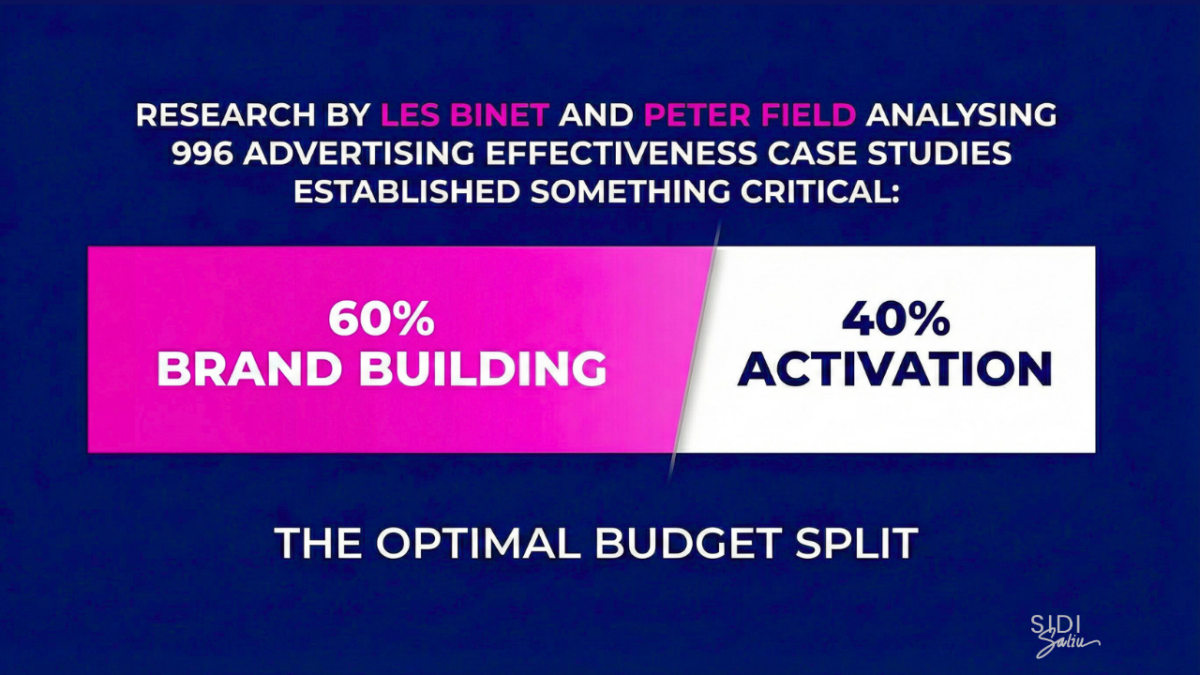
Research by Les Binet and Peter Field analysing 996 advertising effectiveness case studies established something critical: the optimal marketing strategy budget split is 60% brand building and 40% activation.
Brand building creates mental availability. It makes your company the obvious choice when someone enters the market. Activation captures existing demand through performance marketing and direct response.
Most companies flip this ratio. They spend 80% on activation (Google ads, lead gen, promotional campaigns) and 20% on brand. Then they wonder why customer acquisition costs keep climbing and why leads need heavier discounts to convert.
Here’s what happens: activation works great at first. You get immediate feedback. Clicks turn into conversions. Leadership sees ROI.
But you’re only reaching the 5-15% of category buyers who are ready to purchase right now. Research from LinkedIn B2B Institute and the Ehrenberg-Bass Institute confirms that 95% of B2B buyers are out-of-market at any given time. They’ll buy eventually, but not today.
If you’re not building brand with those 95% of future buyers, someone else is.
When they enter the market six months from now, you won’t be on their shortlist. Your competitor who invested in long-term visibility will be.
Why results actually take time
Let’s be honest about something uncomfortable: marketing results don’t show up in thirty days.
Not because marketers are slow. Because behaviour change is slow.
Think about how you make buying decisions. You don’t see one LinkedIn post and immediately request a demo. You see multiple touchpoints over weeks or months. You read content, check reviews, compare alternatives, discuss with colleagues.
Marketing Week’s research shows that winning brands, those experiencing revenue growth, are 75% more likely to combine brand building with sales activation, compared to just 63% of losing brands. B2B buyers consume 3-7 pieces of content before engaging with sales. That content doesn’t get created, distributed, and consumed in a week.
The timeline for strategic marketing initiatives is 6-12 months. Not because that’s ideal, but because that’s reality. LinkedIn’s research found that 96% of B2B marketers expected to see results within two weeks, a fundamental misunderstanding of how marketing actually works.
Brand trust compounds. Each piece of content builds on the last. Each consistent message reinforces positioning. Each proof point adds credibility.
You can’t shortcut trust. You can only build it consistently.
Many “marketing failures” are actually cases of “marketing stopped too soon.” The company invested for three months, saw no immediate spike in pipeline, and pulled the budget.
Then six months later, they wonder why their competitor owns the conversation.
The common leadership misunderstandings that impact marketing success
The most common mistake is mistaking activity for marketing strategy. Leadership sees a content calendar and assumes there’s a plan. But posting three times a week on LinkedIn without a clear positioning strategy is just organised noise.
Another error is expecting marketers to do everything. Brand building, lead generation, events, content, design, analytics. Without prioritisation, you get mediocrity across the board instead of excellence where it matters.
The worst mistake is cutting marketing when revenue dips. That’s like canceling your sales team during a slow quarter. Marketing is how future buyers discover you. Cutting it doesn’t save money. It delays recovery.
So what should leaders be doing instead?
Set both long-term and short-term KPIs. Brand awareness and market position for the long game. Lead volume and conversion rates for immediate impact.
Agree to a 6-12 month evaluation timeline for strategic initiatives. Monthly check-ins to track progress, but patience for results to compound.
Balance your budget using the 60/40 framework. Sixty percent towards brand building (thought leadership, content, positioning). Forty percent towards activation (lead gen, performance marketing, conversion optimisation).
Align on what “marketing qualified lead” actually means. Sales and marketing need shared definitions of lead quality and revenue impact.
The real question
Your marketing team probably isn’t failing. Your expectations probably are.
If you’re measuring marketing like a vending machine, you’ll keep getting disappointed. If you treat it like a compound growth engine, you’ll start seeing returns that last.
Strategy gives tactics purpose. Tactics give strategy life. You need both, in the right proportion, with realistic timelines.
The companies that understand this don’t just survive. They build pricing power, customer loyalty, and market position that competitors can’t replicate with a bigger ad budget.
The question is whether you’re willing to invest in what works over time, or keep chasing what feels productive right now.
My final thoughts
Marketing teams are not failing. They are being asked to deliver long-term growth on short-term timelines, with shrinking budgets and unrealistic expectations.
The companies that win in 2026 and beyond will be the ones that rebalance their approach. They will invest in strategic clarity, protect the 60/40 split, and give their teams the time and resources to build trust that converts.
If you want support realigning your marketing, setting up a realistic strategy, or building a plan your leadership team can get behind, I help businesses do exactly that.
With love, Sidi
Your On-Demand Marketer
Helping leaders and founders build brands people trust, without wasting time or budget.