
Table of Contents
A winning social media strategy for SMEs isn’t about being everywhere. It’s about being exactly where it counts.
Let me guess, you’re posting on LinkedIn, Instagram and maybe Twitter. Your team’s scrambling to keep TikTok fed because someone said that’s where the attention is now. You’ve got a blog that gets updated when there’s time (which is never). And an email list you feel guilty about neglecting.
How’s that working out?
If you’re honest, probably not great. Your team is exhausted. The content feels generic because you’re rushing to feed multiple platforms. And despite being “everywhere,” you’re not seeing the leads or engagement to justify all that effort.
Let me be frank here, more channels doesn’t equal more results, it equals more burnout.
I’ve watched this play out dozens of times with SMEs. They’re stuck in what I call the “ticking boxes” trap, believing that being on every platform equals doing marketing properly. It doesn’t. It equals diluted messaging, burnt-out teams, and content that technically exists but does nothing for you.
But here’s what changes everything: when an SME finally decides to focus on just 1-2 channels instead of trying to be everywhere, the relief is immediate. The first thing that changes is they stop panicking.The hidden cost of being everywhere
Here’s what actually happens when you spread thin across multiple channels.
Your team burns out. 83.3% of marketers report experiencing burnout at some stage in their careers, the highest rate of any industry. Over half feel overwhelmed. Half experience emotional exhaustion.
The pressure to manage multiple platforms creates what researchers call “scaling fragmentation” rather than scaling revenue.
I had a client, a B2B software company that came to me wanting to be on TikTok, Instagram, LinkedIn, and Twitter. When I asked why, they said “because that’s whats trendy in social media”
So I pushed back. Let’s talk to your customers first.
We did basic research. Looked at where their actual deals came from. Talked to their sales team. Turned out every single qualified lead was coming from LinkedIn and word-of-mouth referrals.
Their customers were senior decision-makers who weren’t even on half those platforms.
The thing is, each platform has its own culture and expectations. What works on LinkedIn – longer, more professional posts with insights , falls completely flat on Instagram where people want visual storytelling.
If you’re taking that LinkedIn post and dumping it everywhere, people can tell. It feels lazy. The algorithm picks up on it too. If people aren’t engaging because the content doesn’t fit the platform, you’re shouting into the void.
You end up with content that technically exists on multiple platforms but isn’t actually doing anything for you.
The 1-2 channel social media strategy that actually works
Most SMEs start with tactics. They have this notion of what they think marketing is. They see marketing outputs but don’t see the behind-the-scenes work that creates effective marketing.
There’s a content strategy. A content plan. You’re thinking about what keywords people are searching for, what their pain points are.
You need to understand your customer’s problems to create content that matters. Then you align that content with the services and solutions you offer.
Instead of spreading thin, we focused everything on LinkedIn for that software company. But we did it properly.
We interviewed their customers about their biggest frustrations before buying software. Implementation nightmares, hidden cost and poor support.
Then we built content around solving those specific pain points. Real stories. Practical advice. Not just “look at our product.”
Within three months, their engagement went up. More importantly, their sales team was getting inbound messages from prospects who’d read the content and already understood the value.
That’s what happens when you start with pain points instead of platforms.
When I’m helping an SME figure out their core channels, I look at a few things together:
Where your customers actually spend time – not just where they exist. Someone might have a Twitter account, but are they actively using it for business research? Probably not.
- Where conversations are already happening in your industry. If you’re in B2B professional services, LinkedIn is obvious. But maybe there’s a niche community or forum where your exact audience is asking questions.
- Your sales cycle. If you’ve got a long, complex sale, you need a platform that allows for deeper content and relationship building. That’s not Instagram stories. You need somewhere you can educate over time.
- What your team can actually sustain. If you’ve got one person doing marketing, they can’t produce daily video content for YouTube while managing a LinkedIn presence. You have to be realistic about capacity.
- Where you can own the relationship. Email generates between £30-46 for every pound spent. Social platforms can change algorithms overnight. Email is the only channel you own 100%.
I also tell people to record your sales calls. You can learn a lot from discovery calls and client conversations. Find out where they get their information. Do they like blogs? Webinars? Industry events?
You can always find the channels. Then pick one or two and do those really well. Once they’re working, you move to the next one. You do this until you’ve got the capacity to do more.

How to actually choose your channels (without guessing)
Here’s the framework I use with clients. It’s not complicated, but it requires honest answers.
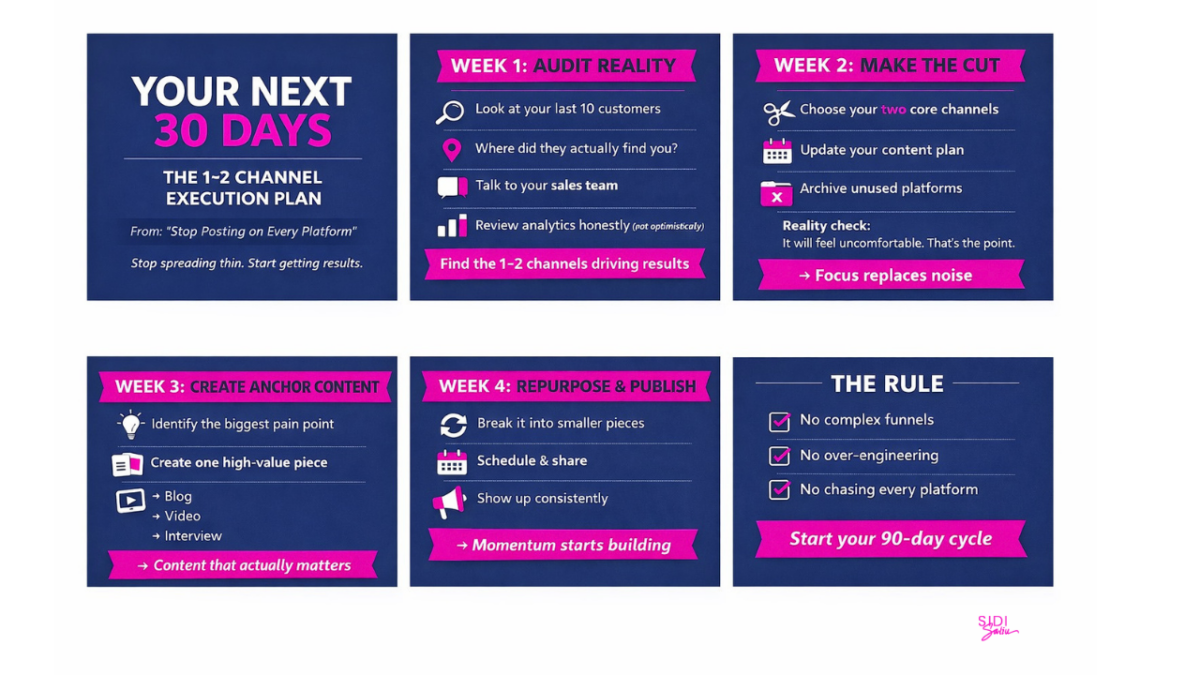
Step 1: List where your last 10 customers found you
Not where you think they found you. Actually ask them. Look at your CRM. Talk to your sales team. If 7 out of 10 came from LinkedIn or referrals, you’ve got your answer.
Step 2: Score each potential channel on four factors
Give each channel a score from 1-10:
- Audience concentration: How many of your ideal customers are actively using this platform for business research?
- Content-market fit: Does your expertise translate well to this format? (Written insights work on LinkedIn; visual tutorials work on YouTube)
- Team capacity: Can you sustain quality content here with your current resources?
- Conversion proximity: How close is this channel to actual buying decisions? (LinkedIn is closer for B2B than TikTok)
The two channels with the highest combined scores become your focus. If there’s a tie, pick the one where you already have some traction.
Step 3: Commit to 90 days minimum
This isn’t a one-month experiment. You need at least 90 days of consistent, quality output before you can assess if it’s working. Mark it in your calendar. No second-guessing before then.
What if you pick the wrong channel?
But what about if you pick the wrong channel? So what!? you might choose wrong. And that’s okay, if you know what to look for.
After 90 days of consistent effort, look for these warning signs:
Your content gets views but zero engagement. People scroll past. No comments. No DMs. No sales conversations. This usually means your audience isn’t actually there, or you’re not addressing real pain points.
You’re getting engagement from the wrong people. Lots of likes from other marketers or competitors, but none from potential customers. You’re in an echo chamber.
The effort-to-outcome ratio is broken. You’re spending 10 hours a week producing content and getting nothing back. Not even brand awareness. Just crickets.
Your sales team reports zero influence. When they talk to prospects, no one mentions your content. No one says “I’ve been following you on X.” That’s a red flag.
If you’re seeing these signs after 90 days of genuine effort – not half-hearted posting, but real strategic content – it’s time to pivot.
Here’s how to pivot without falling back into the “everywhere” trap:
Go back to your scoring framework. Look at your second-highest scoring channel. The one you didn’t choose initially. That’s your next test.
Take what you learned. If your content wasn’t resonating, the problem might not be the channel – it might be your messaging. Make sure you’re actually addressing customer pain points, not just talking about your services.
Give the new channel the same 90-day commitment. No cutting it short because you’re impatient. No adding a third channel because you’re anxious.
The key difference between pivoting strategically and panicking back into multi-channel chaos? You’re making one deliberate change based on data, not scattering yourself again out of fear.
What “really well” actually looks like
Go all in on the channels you’ve chosen.
If your two channels are LinkedIn and blogs, do those well. By doing that well, I mean if you’re going to write a blog, make sure you’ve done your keyword research. You’ve optimised the blog fully for that channel.
If you’re going to do LinkedIn, make sure you do it properly.
Really well means: Is it adding value? Are people going to want to interact with this post? Does it touch on a pain point? Is it teaching something or entertaining?
Have a guardrail. If we’re producing content, these are the core objectives of each piece. If you’re matching that and spending time on it, it’s going to take more effort than just posting stuff.
You have to think about the key value of the content you’re producing.
What’s one channel you know you should double down on right now?
The truth is, results don’t come from being everywhere. They come from committing to the right place and showing up consistently with something that actually matters.
Focus beats noise, every single time!
If you’re feeling overwhelmed or unsure where to focus, send me a DM. 💖💙
With love, Sidi
Helping leaders and founders build brands people trust, without wasting time or budget.