

Table of Contents
Your competitors are publishing more than ever. So are you. Everyone’s feeding the content machine, ticking boxes, filling calendars.
And your audience has stopped paying attention.
Why? Because most of it sounds exactly the same…
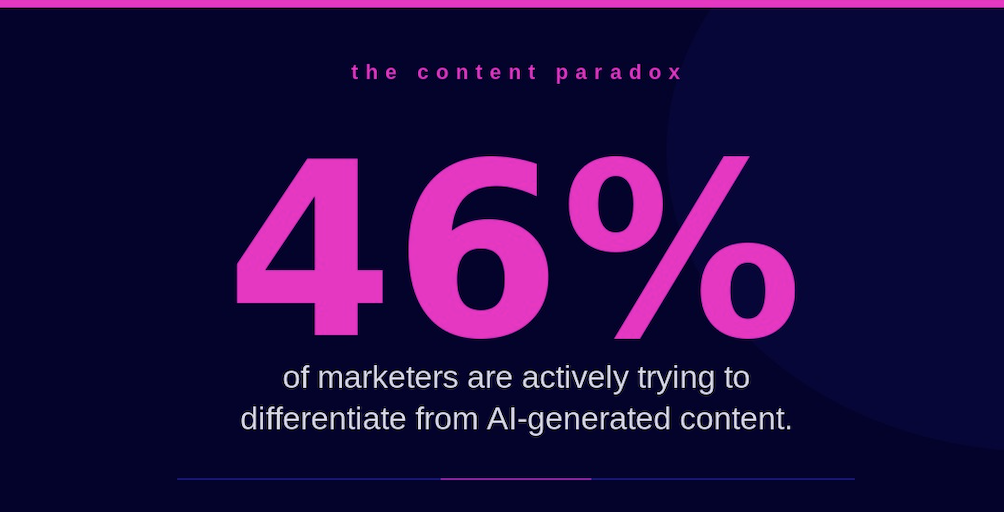
When 46% of marketers are actively trying to differentiate themselves from AI-generated content, you know we’ve hit a turning point. The problem isn’t that AI writes badly any more. The problem is that it writes just well enough to flood the internet with perfectly mediocre content that all sounds like it came from the same template.
And your audience can tell.
Just because AI makes it easier to publish more doesn’t mean we should publish indiscriminately. Speed without strategy alienates your audience faster than saying nothing at all. When you prioritise quantity over value, you’re not building authority. You’re training people to ignore you.
In this article, I’ll break down what actually works in a world where AI has made content production faster and easier than ever. You’ll learn how to stand out, what to focus on, and what you need to succeed when everyone else is racing to publish more.
Let’s talk about trust
Before we go any further: AI-generated content isn’t inherently bad. I’m a big user of AI and share my learnings all the time. If it adds genuine value and you can see that when care and thought have gone into it, it can work perfectly well. The issue isn’t the tool. It’s when content feels mass-produced and indistinguishable from everything else flooding the internet.
Let me share something that should make you rethink your content strategy entirely.
Here’s what UK data reveals about trust and AI content:
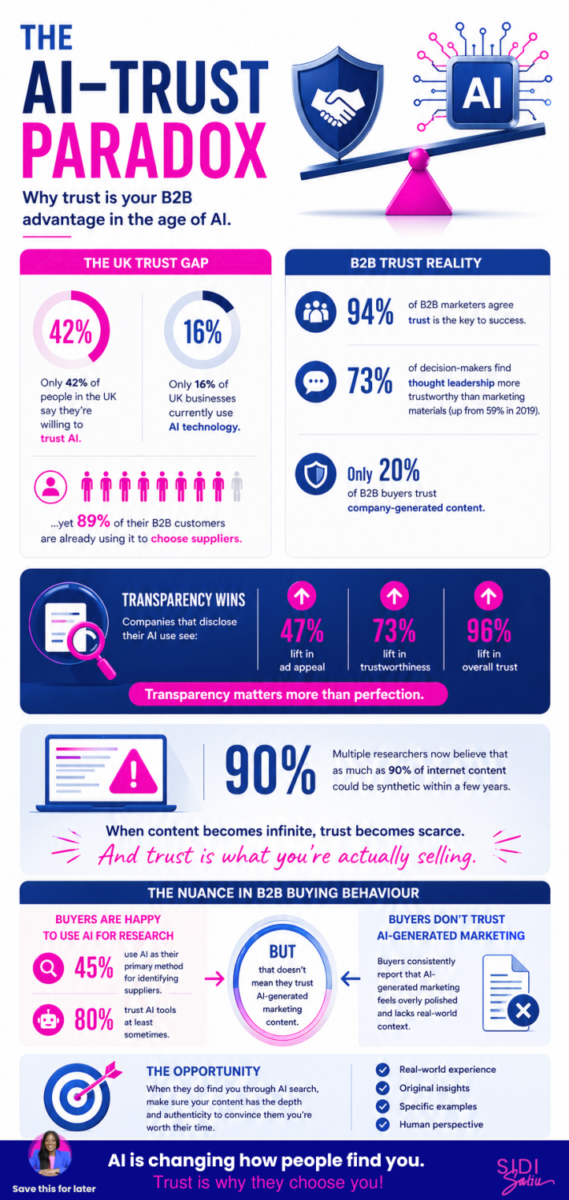
Only 42% of people in the UK say they’re willing to trust AI. And whilst , 89% of their B2B customers are already using it to choose suppliers.
In B2B specifically, 94% of marketers agree trust is the key to success, and 73% of decision-makers find thought leadership more trustworthy than marketing materials (up from 59% in 2019). Yet only 20% of B2B buyers trust company-generated content.
Here’s the interesting bit: companies that disclose their AI use see a 47% lift in ad appeal, 73% lift in trustworthiness, and 96% lift in overall trust. Transparency matters more than perfection.
Multiple researchers now believe that as much as 90% of internet content could be synthetic within a few years.When content becomes infinite, trust becomes scarce. And trust is what you’re actually selling.
The nuance in B2B buying behaviour tells the full story. B2B buyers are happy to use AI tools for research, in fact, 45% use AI as their primary method for identifying suppliers, and 80% trust AI tools at least sometimes. But that doesn’t mean they trust AI-generated marketing content. Buyers consistently report that AI-generated marketing feels overly polished and lacks real-world context. The opportunity here? When they do find you through AI search, make sure your content has the depth and authenticity to convince them you’re worth their time.
What AI search engines are actually looking for
I spend a lot of time thinking about how content gets discovered. The rules have changed faster than most people realise.
Research from March 2026 found something fascinating: AI search engines filter out roughly 95% of retrieved content before generating an answer. Traditional SEO signals like Domain Authority explain very little about what gets cited.
So what does matter?
Original data.
Content with three or more original data points receives 2.5x higher citation rates than generic content. The machines are looking for sources of truth, not echoes of existing information.
Think about what this means for your content strategy. Publishing more of the same won’t help you. Publishing something nobody else can say will.
The B2B advantage you’re missing
If you’re in B2B, pay attention to this number: 90% click-through rates on AI Overview sources compared to 8% for general users.
B2B buyers engage with cited content at dramatically higher rates. They’re looking for credible sources to inform their decisions. When you position yourself as that source, you don’t just get traffic. You get qualified attention from people ready to buy.
The quality over quantity shift
I’ve watched too many SME founders burn out trying to keep up with publishing schedules that don’t move the needle.
Here’s what the data actually shows: businesses that focus on content quality generate 13 times more ROI than those prioritising quantity.
Thirteen times.
High-quality, relevant content generates 9.5 times more leads than low-quality, non-targeted content. You don’t need to publish every day. You need to publish something worth reading.
This isn’t about writing longer articles or using fancier words. Quality means:
- Original insight from your actual experience
- Specific examples instead of generic advice
- Clear takeaways people can apply immediately
- Your actual voice, not a polished corporate version of it
The content that performs best in 2026 reads like a conversation with someone who’s done the work and wants to help you avoid their mistakes.

5 ways to build your source of truth strategy
Let’s be honest about what sets you apart. It’s not your ability to summarise what everyone else is saying. It’s what you know that they don’t.
Here’s how I’d approach building a source of truth positioning if I were starting today.
1. Document your proprietary data
You have information nobody else has. Client results. Failed experiments. Patterns you’ve noticed across dozens of projects. Industry observations from your specific vantage point.
Start tracking it. Your experience is data.
When you reference specific numbers, timelines, or outcomes from your work, you create content that can’t be replicated by AI. The machines can summarise existing knowledge. They can’t replace lived experience.
2. Develop your point of view
Generic best practices don’t differentiate you. Your specific take on why certain approaches work or don’t work does.
I’m not saying be contrarian for the sake of it. I’m saying develop and articulate what you actually believe based on what you’ve actually seen.
The strongest thought leadership comes from people willing to say ‘here’s what works in my experience’ even when it contradicts conventional wisdom.
This is also where a clear tone of voice becomes essential. You can’t just tell people to ‘sound more human’. You need a framework that captures what makes your brand distinct whilst giving people room to be themselves.
Through tone of voice workshops, I help teams develop guidelines that actually get used. Not a 50-page document that sits in a drawer, but practical tools that help people write with confidence and consistency. When your tone is clear, your content stands out even in a sea of sameness.
3. Make humans visible
Companies with multiple credible humans speaking clearly and consistently almost always outperform a single polished brand channel.
Social platforms now reward credibility over volume. Human voices outperform brand accounts. Employee and executive posts drive higher engagement and visibility than corporate channels.
58% of decision-makers will choose a business based on thought leadership content. Another 35% spend at least one hour daily consuming it. Over half say high-quality thought leadership prompts them to research an organisation’s capabilities.
Your people are your differentiation strategy. Let them speak.
This is where employee advocacy and personal branding become critical. When your team members develop their own voices and share insights from their roles, they create multiple credible touchpoints for your brand. It’s not about everyone saying the same thing. It’s about authentic perspectives that collectively build trust.
I work with businesses on exactly this through personal branding programmes and employee advocacy strategies. The goal isn’t to turn everyone into influencers. It’s to help your people communicate their expertise in ways that feel natural and build genuine authority.
4. Use AI as a tool, not a replacement
Real talk: this isn’t about avoiding AI. It’s about using it correctly.
AI handles routine content production brilliantly. First drafts. Research summaries. Structure suggestions. Editing passes. These are all fair game.
What AI can’t do is replace the uniquely human insights that inform your overall content strategy and creative direction. The strategic thinking about what to say and why it matters comes from you.
Brands that establish transparent AI usage policies build greater trust with audiences. You don’t need to pretend you’re writing everything by hand. You need to make sure the ideas are genuinely yours.
5. Create content worth citing
Ask yourself: would another expert in my field reference this article?
If the answer is no, you’re adding to the noise.
Content worth citing includes:
- Original research or data analysis
- Detailed case studies with specific outcomes
- Frameworks you’ve developed and tested
- Contrarian perspectives backed by evidence
- Comprehensive guides that consolidate scattered information
When other people cite your work, AI search engines notice. When buyers see your name attached to ideas they encounter elsewhere, you become the authority.
What this looks like in practice
I worked with an SME business that was publishing a staggering amount of content. They had set aggressive targets to saturate the market with as much output as possible, believing more visibility meant more leads.
The problem? The content was low value. AI-generated at speed with poor practice. Emoji-heavy. Generic advice recycled from industry trends. No original thinking. No real expertise on display.
Based on my advice, we drastically reduced the volume to one thoughtful blog per month. Each piece became more thought leadership and subject matter expert-led, with proper marketing support to help their experts generate the right type of article. Human oversight, real insights and actual value.
The shift was dramatic. Their audience stopped tuning out. Sales conversations became more substantive because prospects had actually read and engaged with the content. They built credibility instead of noise.
It took more effort upfront to create content with care and thought. But it worked because they stopped treating content as a numbers game and started treating it as a trust-building exercise.
The path forward
You have a choice to make about your content strategy.
You can keep pace with the publishing treadmill, churning out content that sounds like everything else, hoping volume eventually translates to visibility.
Or you can slow down and build something that matters.
Focus on the content only you can create. Document your proprietary insights. Develop your distinct point of view. Make your expertise visible and citeable.
When content becomes infinite, trust becomes scarce. Position yourself as a source of truth in your space, and you won’t need to worry about standing out. You already will.
Where to start
If you’re ready to shift from content volume to content value, start here:
- Audit your last ten pieces of content. Ask yourself: could a competitor have written this? If yes, you’re not differentiated yet.
- Identify three insights only you have. Client patterns. Failed experiments. Counterintuitive observations. These become your content foundation.
- Publish one piece this month that includes original data or a specific case study. Watch how it performs compared to your generic content.
The businesses winning in 2026 aren’t the ones publishing most. They’re the ones publishing best.
There’s no shortcut, but this approach works. I’ve seen it move the needle for SMEs who commit to it.
Your move. What will you differently after reading this article?
The truth is, standing out isn’t about producing more content. It’s about producing content that actually means something.
When everyone can publish, trust becomes the differentiator.
Focus on what only you can say, that’s where the value is.
If you’re feeling overwhelmed or unclear on what to focus on, that’s exactly how I support businesses every day, book a consultation and I’ll see if I can help!
💖💙 With love, Sidi Your On-Demand Marketer
Helping leaders and founders build brands people trust, without wasting time or budget.