
Your mini guide to LinkedIn’s 2026 algorithm changes
Table of Contents
The LinkedIn algorithm just shifted again, and if your reach has felt flat lately, this is probably why.
I feel like its not been that long since i posted my video on how to engage with your favourite creators but that was just the start …
Many professionals are seeing fewer views and lower engagement than they did a year ago. The tactics that worked in 2024, posting frequently and relying on quick reactions, are no longer delivering the same results.
One reason is LinkedIn’s shift towards what many creators describe as a “360° brew” a new LinkedIn algorithm. In simple terms, the platform now rewards people who actively participate across the network, not just those who publish posts.
That means the algorithm looks beyond your content. It also considers how you comment, reply, join conversations, and interact with others on the platform.
For founders, SME leaders, and professionals building a personal brand, this shift is actually good news.
While some users are seeing declining reach, those who understand the new rhythm are building stronger visibility, deeper connections, and more credible personal brands.
In this guide, I’ll break down what’s changed and the five practical actions you can take today to stay visible on LinkedIn.
What is 360 Brew?
“360 Brew” isn’t LinkedIn’s official term, that I could find, but it’s what industry analysts are calling the AI-powered, context-driven reality of the platform’s algorithm that rolled out between 2025 and 2026.
Unlike the old engagement-based model that simply counted likes and shares, this new system evaluates your entire presence: what you post, who engages with it, how long people read it, whether they save it, and crucially, how you participate in conversations across the platform.
The “360” refers to LinkedIn’s holistic view of your profile activity. The “Brew” represents how the algorithm mixes multiple signals together to determine content distribution. Think of it as AI-powered content filtering that demands consistency between what you say you do and what you actually post.
What changed
LinkedIn rebuilt its entire algorithm around a simple principle: relevance over volume.
The platform now prioritises content relevance over posting frequency, aggressively reducing the reach of engagement bait and generic content. It strongly links your profile (headline, about section) to your content, checking if what you post matches what you claim to do.
The platform isn’t rewarding broadcasting anymore. It’s rewarding participation and depth.
How content gets distributed now
Here’s what happens when you publish a post:
Phase 1: Initial test – LinkedIn shows your content to a small slice of your network (typically 1-5% of connections). The algorithm watches closely: Are people reading it? Are they commenting? Who’s engaging?
Phase 2: Credibility check – The system evaluates whether the people engaging are relevant to your topic. Random engagement from unrelated connections doesn’t trigger wider distribution.
Phase 3: Wider distribution – If your content passes both tests, it gets shown to a broader audience. If it fails, distribution stops.
This is why the first hour matters so much. Poor initial performance kills your reach before it begins.

Rule 1: Chase saves and thoughtful comments, not likes
In late 2025, LinkedIn added Saves and Sends to post analytics. This was LinkedIn directly telling creators what it values. Saves and thoughtful comments are treated as stronger signals of value than quick likes.
The data is clear: a post with 50 substantive comments outperforms a post with 500 likes.
But the algorithm has got smarter. According to industry reports, LinkedIn’s VP of Product revealed in a December 2025 briefing that 60% of high-engagement posts in Q3 2025 used at least one optimisation tactic, but user satisfaction scores were declining. The platform responded by teaching its AI to filter out low-value interactions. Comments that are mostly “Great post!” or emoji-only replies from the same small group don’t generate momentum anymore. (which is crazy as when I am time poor, i may just say that …) but now I save the post and reply meaningfully when I have time.
What to do: Focus on earning meaningful comments from the right people in the first hour. Ask questions that spark discussion. Respond to every comment quickly.
Rule 2: Build a relevant network, not a big one
Research tracking B2B profiles found that network relevance dramatically impacts content performance.
Profiles with highly relevant networks saw substantially better results. Engagement from industry-relevant connections carries considerably more algorithmic weight than interactions from random connections.
Translation: who engages with your content matters as much as how many people engage.
What to do: Connect with people in your actual industry. Engage with their content regularly. The algorithm checks if your network matches your topic.
Rule 3: Write content people actually read
The number one ranking factor in 2026 is dwell time.
The algorithm measures how long people actually engage with your content. A post someone reads for 30 seconds outperforms one with 50 quick likes.
What to do: Prioritise depth over brevity. Give people something worth reading that makes them stop scrolling. Aim for 30+ seconds of dwell time.
Quick Tip: for time poor professionals, If you see a post you like and have a view on save the post and reply meaningfully when you have more time.
Your action plan: Five changes to make today!
1. Focus on quality and consistency
Posting frequently does not guarantee reach. LinkedIn distributes posts based on how people interact with them. One thoughtful post that starts a conversation will outperform several low-effort posts. Aim for consistent, useful content rather than high volume.
2. Comment with intention on discussions in your niche
LinkedIn increasingly rewards creators who are active across the platform, not just on their own posts. Comment on relevant discussions, share perspectives, and engage with people in your industry. This helps build visibility and strengthens your network.
3. Encourage meaningful commenting
Comments are one of the strongest signals that content is valuable. Instead of chasing likes, write posts that invite opinions, questions, or debate. When people respond, continue the conversation. Active discussion helps posts travel further.
4. Respond and stay present after posting
The period after publishing matters. Reply to comments, acknowledge people who engage, and keep the conversation moving. This increases dwell time and signals that the post is generating genuine interaction.
5. Be clear about your topic and expertise
LinkedIn distributes content more effectively when it understands what you talk about. Keep your profile, headline, and posts aligned with your area of expertise so the platform can show your content to the right audience.
Showing up on LinkedIn
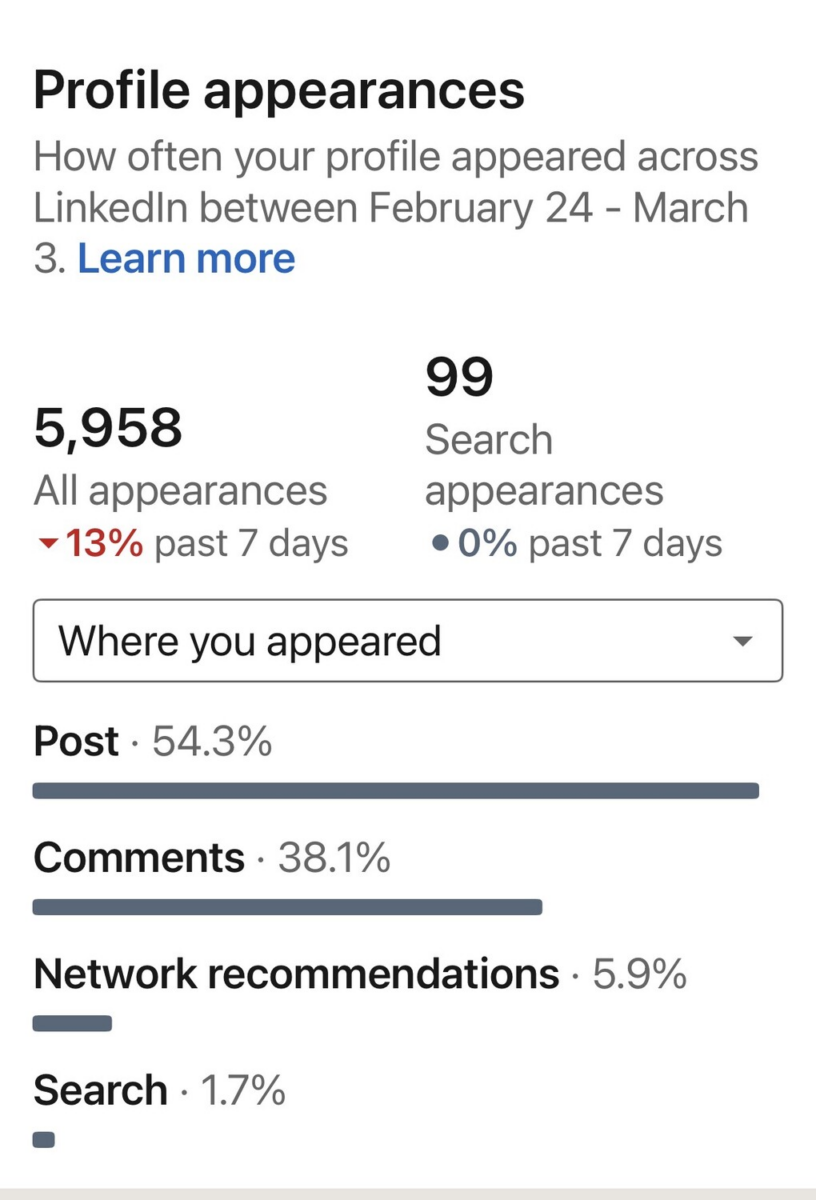
Linked itself is telling you where to show up in your analytics. But you can also check out the official Linkedin guide to understanding LinkedIn profile appearances here.
What to expect
According to Richard van der Blom’s Algorithm Insights 2025 report, organic performance has taken a noticeable hit: views down around 50%, engagement down 25%, and follower growth down 59% compared with the previous year.
But there is an important flip side.
High-quality, niche content is now amplified more strongly than before. When posts demonstrate real expertise or spark meaningful discussion, LinkedIn is more likely to distribute them further across the network.
If you adapt, you will outperform the majority of users who go quiet when reach drops. The algorithm increasingly rewards depth, consistency, and genuine participation.
Final reflection
LinkedIn hasn’t stopped rewarding good content. It has simply become more selective about what it promotes.
The professionals who continue to show up, share thoughtful ideas, and participate in conversations will still be seen.
Focus on contributing to your industry rather than chasing the algorithm. Over time, the visibility follows.
If you’d like more practical insights on LinkedIn, personal branding, and SME marketing, you can read more of my articles here: https://www.marketingcollaborators.com/blog
With love always, 💖💙
Sidi, Your On-Demand Marketer
Helping ambitious marketing teams and founders turn marketing into revenue, without wasting time or budget.