

Table of Contents
The founder bottleneck is one of the most common growth killers I see. Every founder I talk to is always about to sort their marketing. They tell themselves the website needs work first. They promise to be more consistent on LinkedIn next quarter. They rely on relationships and a bit of luck to keep sales flowing.
Shockingly, nearly half of all businesses still don’t have a digital marketing strategy (Emarsys, 2024). You’re in crowded company.
Unfortunately, what most founders don’t realise is that delaying costs a lot more than you think.
What the Founder Bottleneck Actually Costs
Start with the time you’re burning. Sales reps spend 40% of their time just searching for someone to call (Inside Sales, 2024). When your positioning isn’t clear, every conversation starts from scratch. Every prospect call becomes an explanation session instead of a sales conversation.
Now add up the people cost. You’re paying your team to work in the dark. Your sales team keeps asking for better materials. Your product team doesn’t understand why nobody knows about the features they built. Everyone can see the gap, but nobody owns fixing it.
Then there are the opportunities you’re missing while you wait.
A competitor launches something similar and suddenly owns the narrative you should have claimed months ago. Potential clients you could have nurtured are buying from someone else. Conference speaking slots go to people who’ve been more visible.
When marketing doesn’t exist or doesn’t work, founders compensate by doing all the selling themselves. Every prospect call. Every follow-up. Every pitch deck.
The pattern is predictable. 40% of companies never get past £2.5M because they get stuck moving beyond founder-led sales (Notion VC, 2024). For those that push through, 60% stall between £2.5M and £8M, failing to find a functional go-to-market model (Notion VC, 2024).
The absence of strategy doesn’t just slow growth. It creates a different problem: you become the bottleneck.

The hidden pressure
There’s another cost that doesn’t show up in spreadsheets.
53% of founders experienced burnout in 2024 (Founder Institute, 2024). When you’re personally responsible for every sale, the pressure becomes constant. Every hour spent selling is an hour you’re not spending on product, strategy, or building the team.
The emotional volatility is real. A good sales month feels like validation. A slow month feels like failure. Your mood tracks your pipeline, and that’s exhausting.
There’s another cost that doesn’t show up in spreadsheets.
53% of founders experienced burnout in 2024 (Founder Institute, 2024). When you’re personally responsible for every sale, the pressure becomes constant. Every hour spent selling is an hour you’re not spending on product, strategy, or building the team.
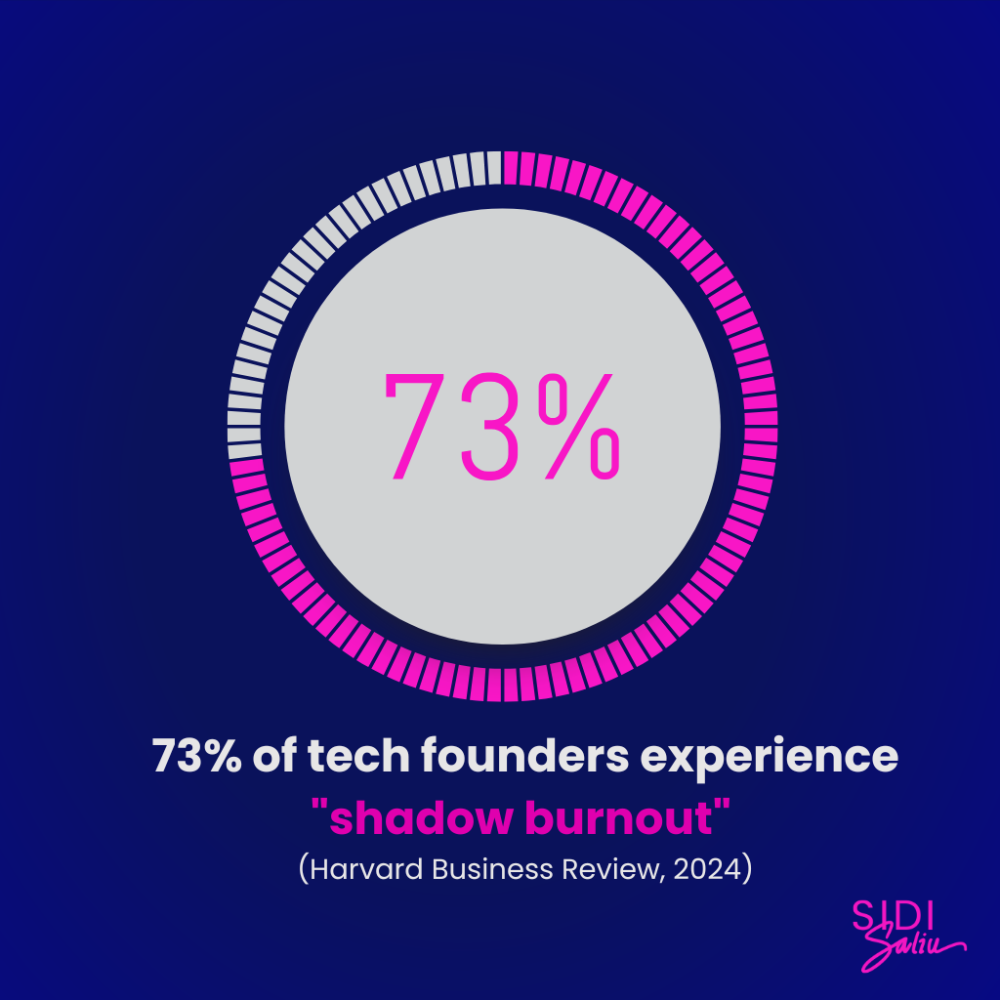
The emotional volatility is real. A good sales month feels like validation. A slow month feels like failure. Your mood tracks your pipeline, and that’s exhausting. Research shows that 73% of tech founders experience “shadow burnout” (Harvard Business Review, 2024): persistent exhaustion hidden behind continued high performance. You keep performing while slowly depleting from the inside out.
The crisis stays invisible until it’s not.
Why founders wait
Most founders don’t delay marketing because they don’t believe in it. They delay because they’re uncertain about what to do and afraid of public missteps.
The fear makes sense. Marketing feels exposed. Sales happens in private conversations. Marketing happens where everyone can see.
But uncertainty has a price tag. 22% of failed businesses didn’t implement the correct marketing strategies (CB Insights, 2023). That’s one of the top reasons startups fail, ranking higher than team problems and nearly matching product-market fit challenges.
The cost of inaction isn’t just tactical. It’s existential. And yet, the founder bottleneck keeps most from taking the first step.
Three decisions that will help you break the cycle
Before the year ends, make these three decisions:
- Define what you want to be known for. Not your entire positioning. Not your complete brand story. Just one clear statement about the problem you solve and who you solve it for. Write it down. Share it with your team. Use it as a filter for every piece of content you create.
- Determine who owns marketing. This can be internal or external, but someone needs clear accountability. Marketing by committee doesn’t work. Marketing as a side project for your product team doesn’t work either. If you hire externally, you still need to provide direction. Agencies and freelancers can execute, but they can’t replace your strategic clarity about what matters.
- Identify what to stop. Most founders need to do less, not more. Look at your current activities and cut anything that doesn’t directly support what you want to be known for. That half-finished blog? Stop.
Inconsistent effort kills credibility faster than no presence at all. If you’re posting sporadically or sending newsletters when you remember, shift to a rhythm you can sustain (monthly instead of weekly, quarterly instead of monthly) or bring in freelance support to maintain consistency for you. Progress comes from showing up predictably, not from ambitious schedules you can’t maintain.
What happens when you decide
I’ve seen what shifts when founders stop waiting and start deciding.

Sales conversations change. When your marketing clearly communicates what you do, prospects arrive with context. You spend less time explaining basics and more time discussing fit.
Your credibility grows. Consistent visibility builds trust faster than sporadic brilliance. People need to see you multiple times before they’re ready to reach out.
Your team gets clarity. When everyone knows what you’re known for, they can support it. Your product team builds features that reinforce it. Your sales team tells stories that align with it.
The pressure on you personally decreases. Breaking the founder bottleneck starts here. Marketing doesn’t replace founder-led sales immediately, but it creates leverage. You’re no longer the only person generating interest.
The choice in front of you
You can wait until everything feels ready. Until the website is perfect. Until you have more time. Until you’re certain about every detail.
Or you can make three decisions this week and start moving forward. The cost of waiting is measurable. The benefit of deciding is immediate.
What you want to be known for. Who owns marketing. What you’ll stop doing.
Three decisions, that’s where this starts. DO IT NOW!
The question isn’t whether you need marketing. It’s what you’ll do differently this year.
Final thoughts
In my experience, founders don’t delay marketing because they don’t care about it. They delay because they’re unsure what decision to make first, and the cost of getting it wrong feels high. Every founder bottleneck starts the same way good intentions, no system, and too much pressure on one person.
If this article felt uncomfortably familiar, it’s a signal. You’re already carrying enough. You don’t need to keep compensating for the absence of strategy by doing everything yourself.
If you want support turning those three decisions into something practical, structured, and commercially sensible, you can get in touch.
With love, Sidi
Your On-Demand Marketer Helping leaders and founders build credible, trusted brands without wasting time or budget.